

Cristina Meloni
Soglie (Thresholds)
From 25 October to 2 December 2026
Review
For the most part, identifying a threshold means recognizing it as the boundary between one environment and another. Standing on the threshold—even metaphorically—is a choice that often involves finding oneself at a crossroads, making a decision, or leaving one state behind for another. Actions, transitions, and shifts in state between a “before” and an “after”—these are what Cristina Meloni, in her research, removes from the realm of judgment and clear-cut definition. Meloni’s work Soglie excludes this semantic field to arrive instead at a concept of the threshold that reveals itself curiously through its own linguistic history. Etymologically, the “threshold” is a sort of Frankenstein’s monster of elements, a layering of concepts: it is both above (likely influenced by the Germanic swalja, meaning “foundation beam”) and below (Latin sŏlea, meaning “shoe sole”).
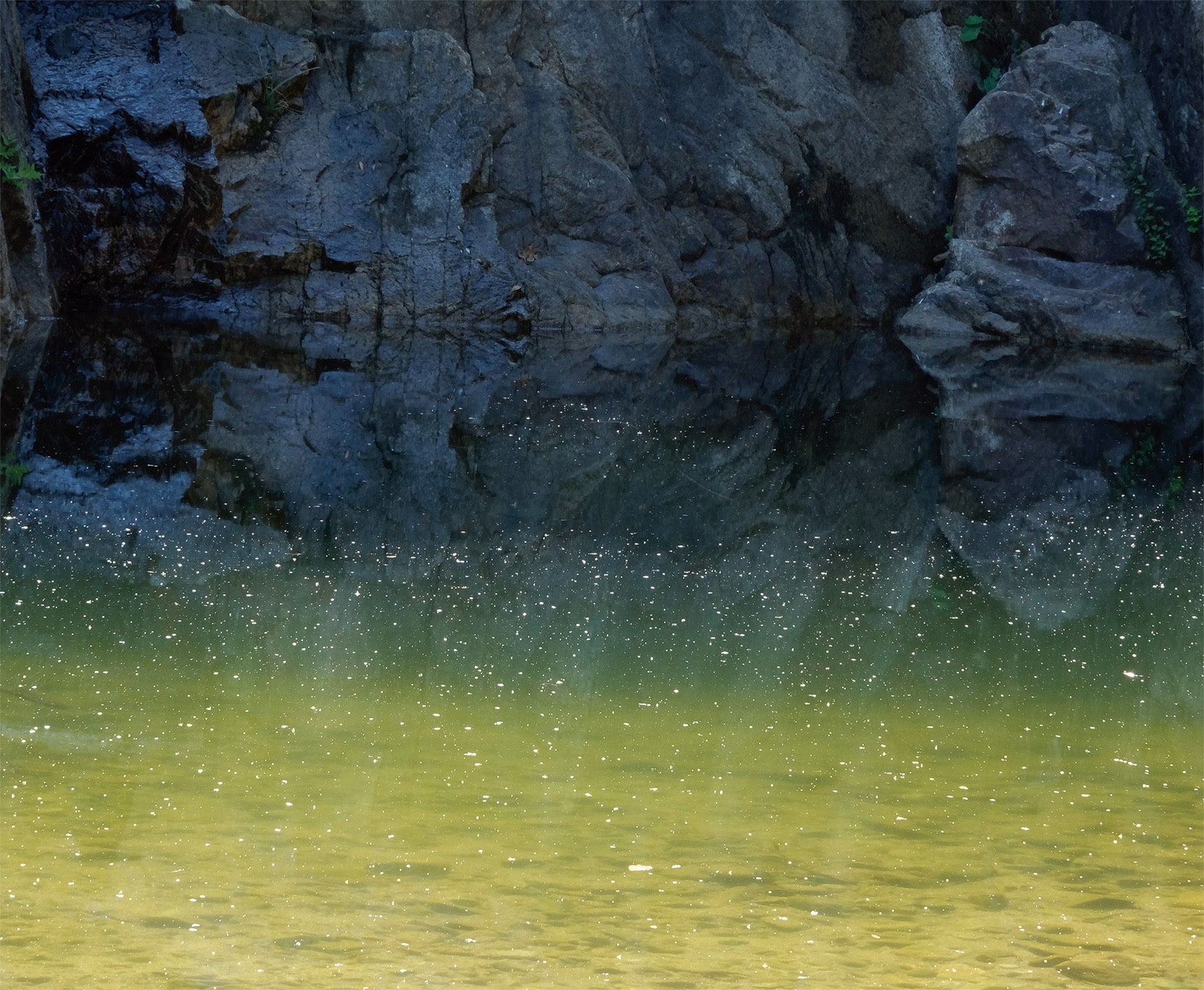
In the exhibition displayed at Organica we encounter a selection of three depictions of clouds, sky, and water, captured directly from reality and not digitally altered. It is in their visual rendering that the artist’s mastery of audiovisual language manifests: photographic and moving images that, though drawn from real-world experience, we simultaneously struggle to situate within a meaningful context. The artist’s mastery of audiovisual language is evident in the control exercised over the image—both in its photographic construction and in its rendering as motion—as well as in the relationship it establishes with the exhibition space. With the aid of monitors, light boxes, and visual projections, Meloni articulates a conscious relationship with the medium of the screen, entrusting each device with a different mode of access to the image. The aim is not to denounce the technological mediation through which we are accustomed to perceiving reality, but rather to explore its possibilities: not merely a means of transmitting the image, but a boundary in itself—the space within which the image comes into being.
Cristina Meloni’s research on Soglie (thresholds) took shape within the framework of PAS – Progetto Atelier Sardegna (2014–2015), beginning with her observation of the gates and boundary walls she encountered during her frequent travels throughout the region. The artist recognizes in these elements visible boundaries, whose function does not necessarily depend on the clarity of their physical demarcation. A threshold can, in fact, be marked by a solid structure, but also by a more uncertain boundary, whose presence is recognized through perception and internalized by those who cross it or approach it. It is in this gap between the physically marked boundary and the perceived one that her investigation begins. An initial presentation of the work in Milan, in the exhibition Pomerium at the Fabbrica del Vapore in August 2015, marked a milestone in the exhibition history of this research. In the following years, Meloni revisited the theme through new works and installations, culminating in the exhibition Colpi di scena (Su Palatu, Villanova Monteleone, 2022). The project thus evolves over time, keeping the threshold at its core as an element that makes a boundary visible without being limited to its material substance.
In 2023, as part of the exhibition “Il sottotitolo è importante – Fuori dal percorso” (The Subtitle Is Important – Off the Beaten Path” (Molineddu Arts Park, Ossi), Meloni recreated the threshold by placing a series of circular mirrors in the middle of the thick grass. Arranged like an invisible floor, the mirrors reflect the sky and the surrounding vegetation, until they are gradually engulfed by the growing grass. The threshold is not made apparent by any manipulation, but emerges through a simple device: a reflective surface placed between the ground and what lies above it.
For Organica, Meloni’s role is that of the creator of the threshold itself, artificially reproducing it through visual materials drawn from nature. In her practice, the artist reworks what surrounds her and manifests itself in everyday life: the natural evolution of things, the succession of events, and the observation of the natural world. This is a process of mimesis, not understood as mere imitation or a faithful reproduction of reality, but as an attempt to re-capture what has caught her attention, in order to convey it through another language.
Let’s look at what the artist has selected for us as an artificial threshold, into which she invites us to immerse ourselves. We wander with our gaze bouncing from one screen to another, through expanses of sky, following the placid drift of the clouds. We stand on the threshold to view them—and this is a fact—but our position in the act of observation is seriously called into question: we are beneath the sky just as, at the same time, we are observing it from above.
We are at the water’s surface, immersed in a mist with an enchanted atmosphere, yet also beneath the surface, enveloped by transparency and reflections. In the screening of the film ACQVA, we fix our gaze on the water reflecting the sky: are we observing its reflection on the surface, or are we immersed in the blue?
The resulting cognitive dissonance leaves us at the mercy of the image, without certainty, in a trance that offers the viewer no reassurance that they can feel in control of the space. Meloni translates this concept into a continuous and seemingly unnatural reversal. The perspective the artist offers us is unexpected and borders on the paradoxical: it is not so much a matter of focusing on what we are observing, but rather of opening ourselves to the possibility of considering two opposing viewpoints that coexist perfectly within the same space. It is the paradox of an “above” and a “below,” an “inside” and an “outside,” each endowed with the same function, positioned on the same axis of equilibrium, and in no way intent on annihilating the other. It is impossible to establish a hierarchy of values within Meloni’s threshold, and it is perhaps this that generates its fascination and, at the same time, the frustration of being unable to fully control something that we tend to believe we can dominate.
The result is a sense of estrangement that disrupts the habit with which we rely on images on the screen, accustomed as we are to viewing them as windows onto reality and tools through which to orient ourselves. The image does not clarify our position but renders it uncertain: the gaze ultimately fails to secure a vantage point from which to reconstruct space, while the possibilities for observing it multiply, to the point of destabilizing the viewer’s very position.
Elena Calaresu
Biography
Cristina Meloni (Alghero, 1983) is a visual artist, cultural practitioner and lecturer at the Foiso Fois Art and Music High School in Cagliari, where she currently teaches Graphic Design and Audiovisual and Multimedia Studies. Her training includes a specialisation in the Art of Photography and Advertising Graphics. Following a substantial period of research and experimentation carried out in Italy and abroad, in 2015 she chose to settle in Sardinia, making the island the focus of her artistic exploration. Her poetic exploration addresses the themes of limits, boundaries and migration, understood not only as physical geographies but as symbolic and existential territories. Through a rigorous method based on observation, recording, cataloguing and reproducing nature and the natural flow of events, the artist transforms natural phenomena into a visual metaphor, capable of exploring the most intimate, fragile and hidden nuances of human experience and memory.
Photographs
(coming soon)
Interview
(coming soon)