

Critique sheet
The title of the exhibition is not only meant to express a place, an enclosed space, a container, but also all the related practices, the ancillary meanings such as restraining, repressing, avoiding excessive manifestations of feelings. The term lends itself to various interpretations, but its semantic centrality lies in defining a function (containing) and an urge not to excessively express feelings and memories. For more than a decade, Pietruccia Bassu’s poetics have been renewing the sense of belonging to a tradition, to a history, building projects on the sense of continuity and re-appropriation of memory.
His basic idea is to find in contemporary practices and languages, the possibility of handing down gestures, techniques, details that belong to his family tradition. The artist from Sassari develops a poetics of art as an archive, as memory but without excessive sentimental afflictions, seeking to make public and share what belongs to his own private life and history. He has also exhibited in places explicitly designated to preserve the documentation of the territory, such as the Historical Archive of the Municipality of Sassari, but in this case he performs an operation on two physical and conceptual levels. He transported the family home in Ittiri into the exhibition space not only ideally, but also through the cadastral plans. In practice, the exhibition space has become a mirror of the parental home, a place undoubtedly where memories and memories are deposited and piled up.
Read the rest of the card
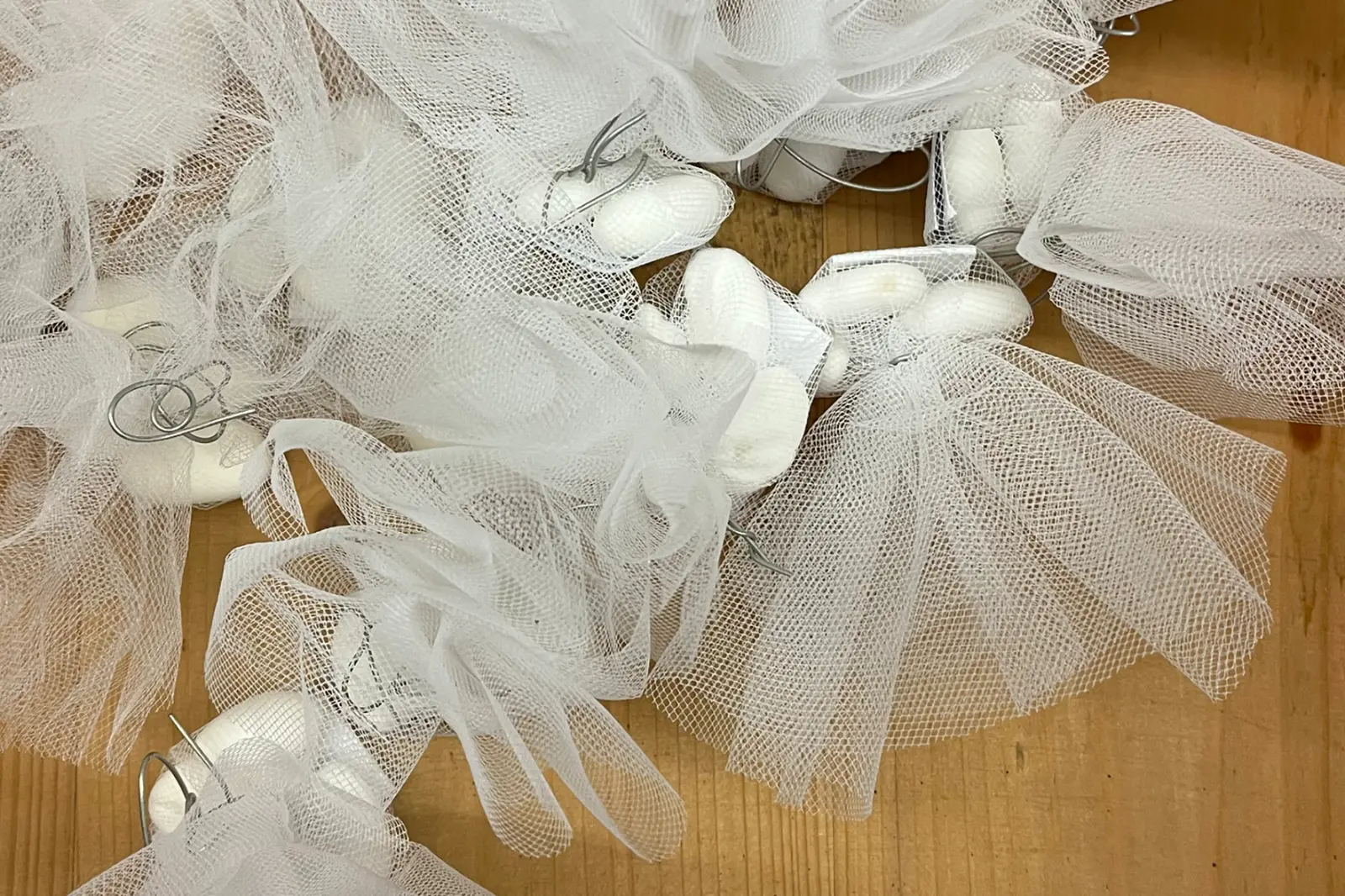
On the ground floor is the public space, the living room, which in a flat is the place where guests are received and socialising takes place. “In this space,” says the artist, “one finds the drawer of dry branches (my shortcomings, absences, guilt), the drawer of overflowing wedding favours and the drawer of trousseau (unfulfilled expectations), the drawer of cut flowers, symbols of death and rebirth, ritual flowers such as chrysanthemums associated with the cult of the dead in the West while in the East they have a completely different and opposite value.
The drawer structure as a display technique is an integral part of the work. Every home possesses its own memory, the walls are fragile containers of affections, of defeats, of things that could have been said and were not said, of things that one wanted to hear but nobody ever said, and also of objects. It is the objects that speak of us in our absence, but it is these that have a life of their own, that show themselves and prove to be bearers of an existence separate from our own. Drawers become not only the containers of stored objects, but also a sort of memory refuge, a direct and simple form of archiving, but also often of unconscious forgetfulness. Orderly structures that try to make up for the overlapping of memories
From the public space we move to the private space on the first floor. The arrangement of drawers contains various categories of objects that also recall Pietruccia Bassu’s previous production. One drawer contains the VITEF skin care cream that evokes the disease and was the artist’s strongest memory of her grandmother, to whom she also dedicated an important performance. Then in one drawer there are boxes with icons of madonnas symbolising prayer and domestic devotion, in another some clothes reminiscent of everyday life, while an empty drawer stands for the renunciations and deprivations in which existence is always rather rich. In this closed and self-reflexive context, the space of nature is that of the ghost. It is a revenant, something that returns, that is part of the universe of what is outside. Clues, traces, subtle references to something that belongs to nature and that man brings back into his history. Borderline or scenario of a possible escape or exit from the prison of memory and its invisible plots that defy time, we do not know, we can only imagine. What there may be outside the container is unknown.
Valerio Dehò
Biography
Pietruccia Bassu was born in Sassari in 1969 and trained at the Academy of Fine Arts in her city. The artist from Sassari belongs to that current that sees in contemporary art the possibility of preserving anthropological data, customs and memories of past generations, using art as an archive, a repository of traces. Bassu researches personal memories aimed at not dispersing the place of origin and its ritual symbols, using different expressive tendencies, from video to installation, and making use of objects with a high symbolic content that in her works take on new aesthetic and conceptual modes. He has taken part in many solo and group exhibitions in galleries and private public spaces in Sardinia and on the Peninsula, including Sassari, Cagliari, Alghero, Berchidda, Bologna, Trevi, Merano, San Lazzaro (BO) and Treviso.
Interview
Photographs
Download
Press Kit
available soon
Press release
available soon