

Ivano Piva
ap:arente’mente
14 May to 15 June 2023
Critique sheet
Appearance, beautiful appearance, is a weapon of mass seduction, a fatal visual trap. ‘The more beautiful the appearance, the worse the deception,’ said Cleon in Shakespeare’s play Pericles, Prince of Tyre. And it is on this ridge, poised between appearance and reality, between environmental degradation and the seductive power of the image, that the unpublished work ap:arente’mente moves, which Ivano Piva has created in the CEDAP space for the Organica contemporary art museum, in which the Turinese photographer combines two moments, one performative, with strong environmentalist implications, and one purely artistic.
The first stems from a subjective experience of the artist that, in part, justifies the title:
“Apparently everything seems normal. Apparently everything seems beautiful.
I sit on the beach, my gaze meets an object that should not be here.
I put it in a bag, I find others, I repeat that gesture many times.
Different form but identical danger. It is no longer all that beautiful.
Other people collect with me, and without speaking,
put them back into my container, which is filled with coloured fragments.
They look almost beautiful; apparently’.
The performative act is also characterised by a double valence: one ritual, but of a secular, civil rituality, for a progressive participatory involvement aimed at raising individual awareness of the disasters caused by the dispersion of plastics in the sea, the other, more systematic, aimed at researching and cataloguing the ‘finds’ of a new, albeit recent, archaeology of plastics. But every rite has its own codified liturgy, with an officiant and, little by little, new followers: Ivano Piva, wearing the vestments of the shaman artist is, at the same time, a leading actor and activator of virtuous emulative processes on the part of a community that one would like to see more and more numerous.
Read the rest of the card
The data, after all, are merciless and call for attention and sharing: “In the sea, on the beaches, along the coasts, we are surrounded by plastic. In particular, as emerges from Legambiente’s Beach Litter 2022 survey conducted at 62 points along the coast, there are 834 pieces of waste for every 100 metres of beach, 84% of which are plastic and 46% are disposable objects. At the top of the waste list is plastic, followed by glass and ceramics, metal, paper and cardboard. And again: plastic bags, shopping bags and envelopes. […] We can therefore speak of a dustbin-sea: it must be said that in this case it is not so much industrial activities and fishing itself that are at issue, which also contributes to the disaster with the bad habit of throwing polystyrene boxes into the water, but rather our lifestyles, our daily habits. In fact, 54% of waste is of domestic origin and leftover plastic ends up in the sea, or on beaches, because we do not properly sort it. The polluters are us, conscious agents of a filth that we pay for three times over: defacing natural beauties where we may spend our holidays, inflating the costs necessary for reclamation, and even eating sometimes poisoned fish at the table’ (www.nonsprecare.it).
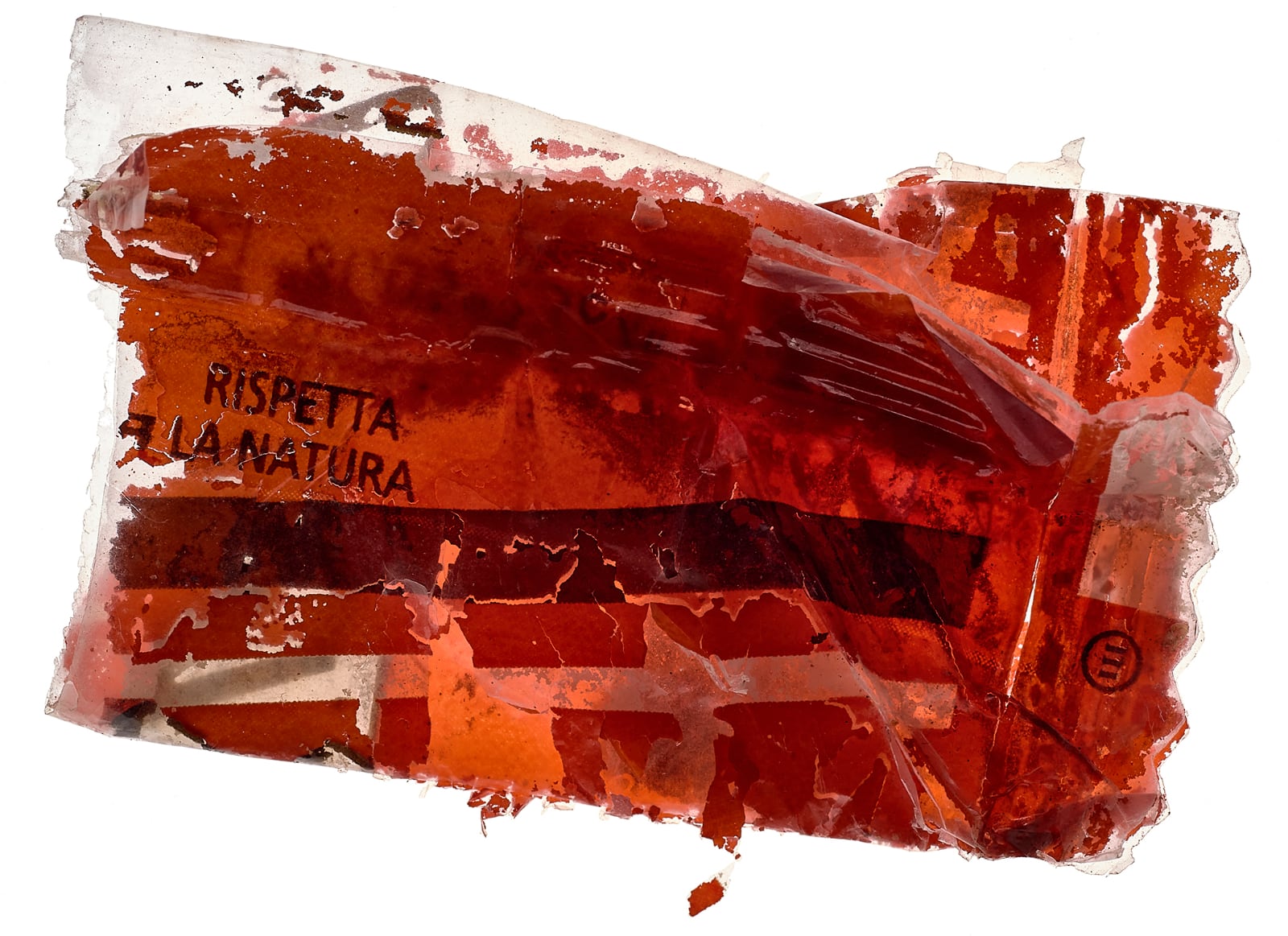
But, as already emphasised at the beginning, Ivano Piva gives his act of witnessing an effective artistic and conceptual value that reinforces its documentary and denunciation intentions. Supported first by a solid background in graphic design and advertising, and then by fashion and still-life photography, he selects the materials collected from the beaches – the real sites of an increasingly macroscopic environmental crime – such as bottles, corks, straws, hanks of fishing nets, various wrappings and everything that is the fruit of senseless consumerism and irresponsible carelessness, and then he re-composes them on an overhead projector to obtain photographic images with a strong visual impact. From such a process formally accomplished works are born, oxymorically abstract although obtained from very concrete and identifiable materials, often with echoes vaguely and intentionally referable to Kandinsky’s early abstract watercolours or to Paul Klee’s more structured works, with the paradox of plunging the spiritual and lyrical dimension of these into a far less poetic abyss of social and environmental decay.
The practice of reusing materials subtracted from the most banal everyday dimension for an aesthetic use has noble origins in art since the early 20th century but, for Ivano Piva, the reference is as precise and absolutely declared as ever: the work of the American photographer Irving Penn from whom he draws both for his classic style and in the peculiar presentation of figures and objects in strong contrast with a mostly white background. But the most direct consonance is above all with the Cigarettes cycles and, above all, Street Material presented at the Metropolitan Museum in New York in 1977, in which Penn photographed discarded, lost or abandoned objects in urban streets, transforming them into photographic subjects and placing himself, with this operation, at the crossroads of artistic and anthropological questions at the same time, in a sort of archaeology of the everyday whose ultimate aim was to give them a new aesthetic value.
The aim of Ivano Piva’s project is opposite: if Irving Penn celebrated the “treasures of the city’s waste” by transforming them into works of art, Piva, on the other hand, by exalting their formal qualities and orchestrating them into compositions that are seductive to the eye and intriguing in the interplay of quotations, does not aim to create works of art but rather visual traps, real attention-grabbers, and those forms that seduce and bewitch us with their “beautiful appearance” actually acquire the sinister meaning of a sort of memento mori for a contemporaneity adrift, victim and executioner of itself, unaware “ofthe terrible doubt of appearances, | of the final uncertainty, that we may be disappointed” (Walt Whitman).
Ivo Serafino Fenu
Biography
Ivano Piva was born in Turin where he studied advertising graphics but was soon absorbed by photography. He first assisted fashion photographers in Milan, then still-life photographers in New York in studios specialising in ‘food photography’. Since 1985 he has worked mainly in commercial photography, collaborating with companies and advertising agencies. Lecturer in shooting techniques at the European Institute of Design from 2003 to 2021, he prefers simplicity in communication. He currently lives in Monteleone Roccadoria, the second smallest town in Sardinia, where he has chosen to move and work.
Interview
Photographs
Available soon
Download
Press Kit
Available soon
Press release
Available soon