

Critique sheet
The title of the exhibition, in fact, does not call for a question mark: yet that graphic sign gives meaning to the questions Giorgio Urgeghe has been asking himself for some time.
It is undoubtedly true that green is the pass that, lately, opens any door and projects us into ideal and consoling worlds. A world of good, just, legitimate things that save the world and soothe the bad conscience. We live in the time of the green, of dazzling green that invites to well-being, to regain the lost paradise, to overturn the mortifying reality. Green therefore represents a U-turn from the past, an awareness that saves goats and cabbages, a mass mission: Linea verde, Il secolo verde, Racconti verdi, just to name a few of the successful titles on TV and in bookshops.
A small word that drags behind it a mountain of topical areas: climate, environment, nature, ecology, health and an infinity of other things. But will this really be the case? wonders a dismayed Giorgio Urgeghe. Is it enough to get on the side of green (but how then?) to leave behind battered nature, environmental disasters, climate change?
Read the rest of the card
Could it be that another myth of today’s culture ready to patch purulent wounds is being built, indeed already in the making?
Over fifty years ago, Roland Barthes published a successful essay for Einaudi: Myths of Today. A lucid, desecrating analysis of the behaviour, objects and imagery of consumer society. Unlike ancient myths, those created by modernity, emptied of their sacred aura and real values in relation to History and Nature, become models of behaviour that are often ambiguous and misleading. I believe Barthes would have no difficulty in including this new formula in his casuistry, which in fact puts everyone in agreement, thus allowing social and cultural differences to be transcended. A generalised behaviour, a colour for all. As only myths can do, making us forget the historical real and letting our minds wander in the fantastic. The power of myths, Barthes calls it myths of words. To expose their fragile and temporary potential, ready to expire. At the same time, he recognises their social and existential necessity as man needs footholds, certainties and truths, albeit muddy or useless, to stem fears. The discourse would obviously take us too far. Let us stop here. And let us simply ask ourselves: green living, why not? Is the formula really viable or is it just a slogan good for all seasons?
Let us take another small digression to observe the history of colours as the history of civilisations, past and recent. Traversed since antiquity and arriving without pause up to the industrial era, the territory of colour is a mirror, from time to time, of dominant power as of popular symbolism, religious systems or illicit superstitions. Venturing into this sphere means coming to terms with an extremely rich bibliography that opens up fascinating scenarios, both in the artistic field and in everyday life. “Colour is not just a colour”, Kassia St Clair reminds us in her beautiful volume “Sentimental Atlas of Colours”, it is, first and foremost, “a cultural construction” that undergoes different and ever-changing uses, meanings and interpretations over time. Manlio Brusatin tells us this in his essay “History of Colours” where, calling on the other great expert Rudolf Steiner, he emphasises the “symbolic and moral action of colour as well as a prophetic and therapeutic function theorised by Steiner”. However, the greatest specialist today seems to be Michel Pastoureau, who has investigated this field in so many ways that he has consecrated it with his astonishing ability as a scholar. A prolific writer, he has dedicated not only a series of pleasant and intriguing texts to colour, but also veritable monographs, among which green could not be left out. Associated over time with “all that is changeable, ephemeral and fickle, green has symbolised childhood, love, hope, luck, play, chance, money and destiny. It is only since Romanticism that it has become the colour of nature and, later, that of freedom, health, hygiene… After having long been sidelined, disliked or rejected, it is now entrusted with the impossible mission of saving the planet.
Giorgio Urgeghe has intercepted this euphoric as well as unmotivated, unrealistic and utopian climate and lays bare the superficial and insubstantial blanket under which the serious problems of a world in distress are hidden.
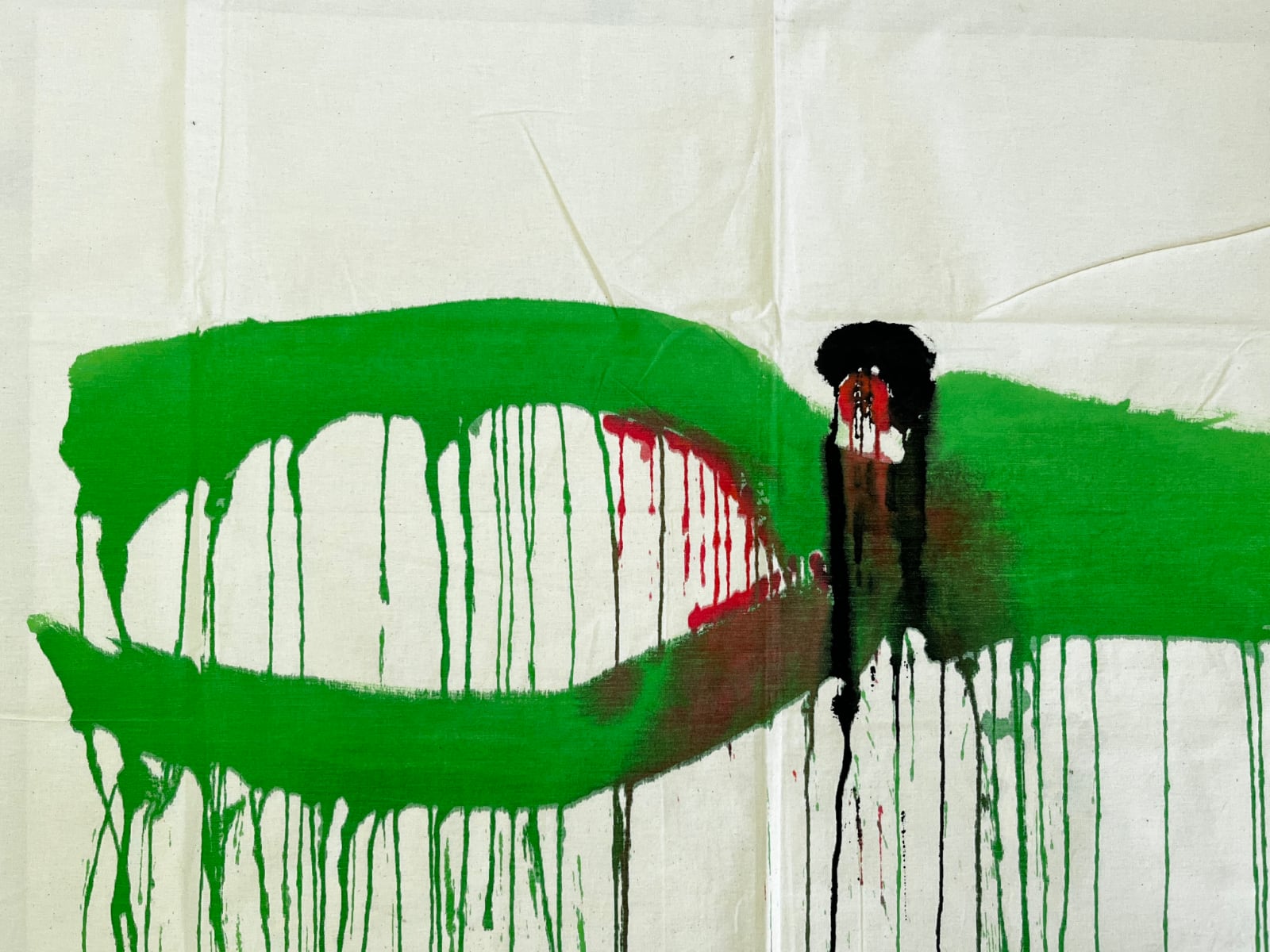
He thus prepares a green exhibition, where everything is green and, if it is not, it is only to highlight it more. An immersive exhibition we would say, played on provocation and visual solicitation, on an anxious and ambiguous aesthetic, on a volcanic and always countercurrent imagery that resents shared codes and rules. Giorgio Urgeghe has made, of authentic and heartfelt non-conformism, a condition of life, and of art.
The exhibition then becomes an incursion into his own experience, into his intimate history that is linked to his very personal way of looking at reality of which he feels the strangeness and superficiality of codified behaviour. How, then, is one to read the presence of sliding doors from which emerges part of a canvas with crocodiles made years ago and rendered docile by that soothing hue? Enclosed then, as a precious find, in a shrine inside which it folds in on itself, transformed into an insidious and indecipherable object. A metaphor of one’s own past still looming, certainly, but also of a present unresolved in its own contradictions and inconsistencies: thus the wardrobe that closes and hides what cannot be revealed, but allows distracted glimpses of its disturbing edges. In fact, a strongly iconic image of this time and this exhibition. Of what is permissible to say and of the censorship that is constantly lurking.
A large installation then, if you like, the one welcomed by the space at the foot of the Limbara, set in the greenery with which Urgeghe establishes a dialectical relationship between true and false, between nature and culture, between artifice and reality. A clear example of this are the plastic bags in which coloured water flows like a disorienting signpost, disorienting the senses and alerting visual perception. In that liquid rainbow, green imposes itself, urged on by the other colours, just as in the small pools in which stagnate, as in precarious spring gardens, chromatic fluids over which the insistent green asserts itself. A disturbing landscape, his, aimed at revealing rather than representing things which, emptied of logical sense, indicate themselves as beacons for alert consciences. Thinking objects themselves. In vain, then, do we ask ourselves where the verdant nature is, in fact it is not there because it is reduced to an invisible horizon, distant and incommunicado, insistently evoked in the bands running along the walls, in reality an interlocutor with no right of reply.
Giorgio Urgeghe’s symbolic and conceptual language therefore proposes a rewriting of reality in arbitrary forms, according to a personal, lyrical and imaginative grammar as only dreamers know how to do. Who while laying bare the false myths and fetishes of the present see its most vulnerable and, why not, even aesthetically tangible side. An aesthetic, his, essential to the extreme reduction of things. With a vein of underlying irony that has always run through his work, played out between a singular existential component and a desecrating yet painful vision of the world.
Mariolina Cosseddu
Biography
Giorgio Urgeghe was born in Sassari in 1963 and lives and works here. After graduating from Sassari’s Istituto Statale d’Arte, in 1986 he was selected for the I Biennale dei Giovani in Sassari. Between the 1980s and 1990s, he was among the protagonists of the various initiatives of the city’s young art movement. His work was immediately oriented in the dual direction of painting and installation, not disdaining other forms of expression such as digital printing. His poetics, often articulated between the childish dimension and that of comic derivation, makes playfulness the inverted mirror of the adult world.
Photographs
Available soon
Download
Press Kit
Available soon
Press release
Available soon