

Press release dated 15 September 2026
On Sunday 20 September at 11.00 am, the Organica Museum of Environmental Art will celebrate the 9th National Day of Small Museums with the opening of two new exhibitions: “Tracce di terra e di vento” (Traces of Earth and Wind) by Caterina Lai and “Atlante. VideoRitratti di Gallura” (Atlas. Video Portraits of Gallura) by Gaetano Crivaro and Margherita Pisano, which will be open to the public until 21 October.
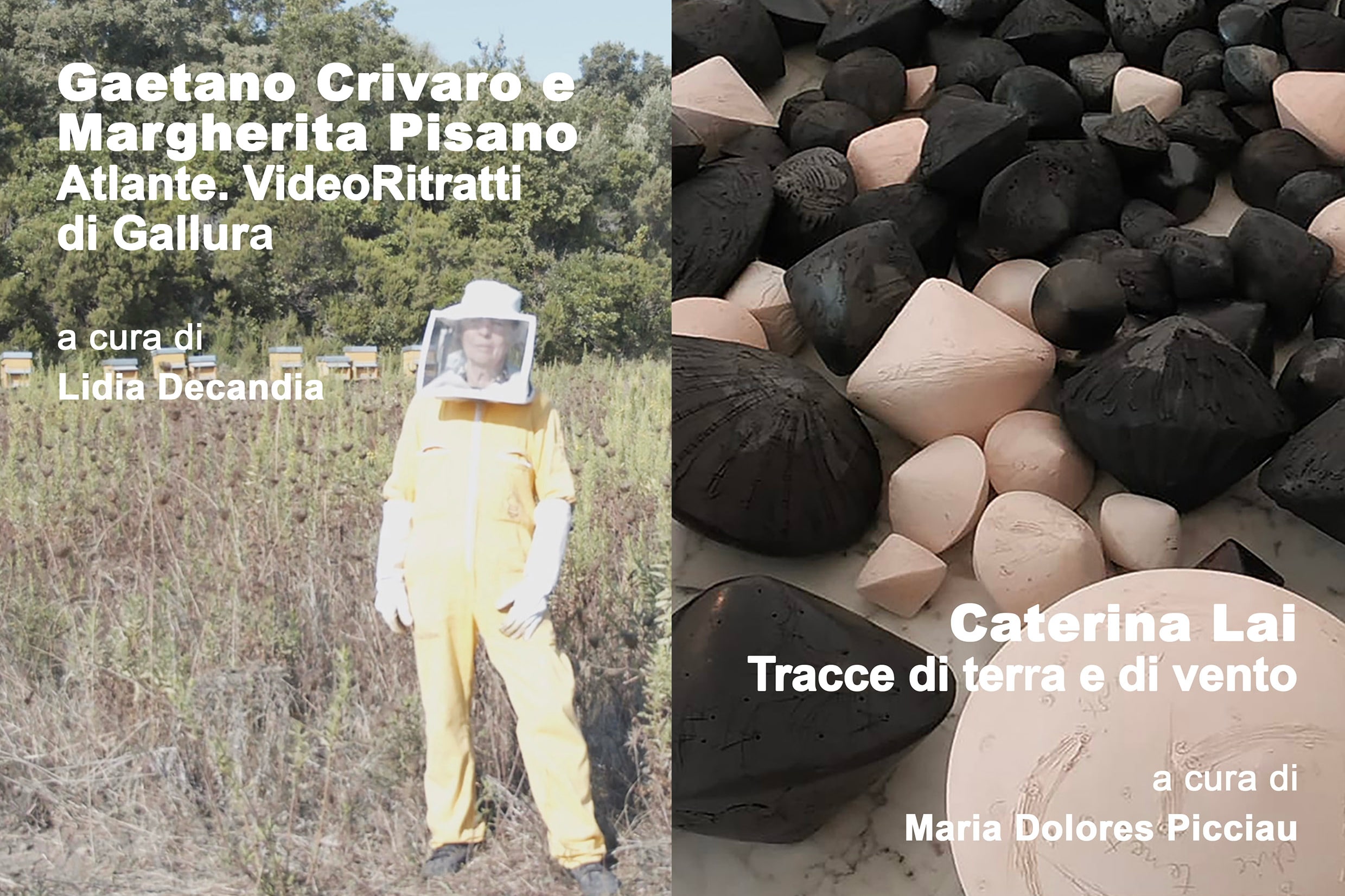
On Sunday 20 September, the Organica Museum will be taking part in the 9th National Day of Small Museums with the opening of two new exhibitions dedicated to contemporary art and the documentation of the local area. The event, organised by the National Association of Small Museums and dedicated this year to the theme ‘Memorabilia’, is a valuable opportunity to engage with contemporary visual arts and the splendid Limbara region, in which the Tempio Pausania Museum of Environmental Art is situated.
On Sunday 20 September at 11.00 am, the halls of Organica Museum will host the opening of two new exhibitions that will form part of the museum’s programme until 21 October. In the contemporary art section, the highlight is “Tracce di terra e di vento” (Traces of Earth and Wind) by the artist Caterina Lai, whilst the section dedicated to the environment is hosting the exhibition “Atlante. VideoRitratti di Gallura” (Atlas. Video Portraits of Gallura) by documentary filmmakers Gaetano Crivaro and Margherita Pisano, curated by Lidia Decandia.
The artist Caterina Lai will be the focus of the new series of events at the Museo Organica for its contemporary art section, with the solo exhibition “Tracce di terra e di vento” (Traces of Earth and Wind), an exhibition curated by art historian and critic Maria Dolores Picciau. The curator writes of the exhibition: “In the tranquil heart of Limbara Park, where millennia-old granite speaks the language of the wind and holm oaks cast their shade, Caterina Lai’s work finds its ideal home. A charismatic figure in the world of artistic ceramics in Sardinia, the Dorgali-born artist does not merely shape the material: she listens to its deep pulse, translating the island’s archaic memory into a visual language of the purest essentiality. Hers is a legacy of artistic expression rooted in an exceptional family tradition — encompassing her father Simeone’s renowned school of ceramics, the brilliant figurative teachings of her uncle Salvatore Fancello, and the geometric precision of her mother Luisa, a master of the art of embroidery. From these ancient traditions, Caterina Lai has inherited the secret of the incisive mark, the ability to transform absence into presence and clay into a diary of the soul. It is in the primordial twilight of the bucchero firing — the alchemical process that deprives the fire of oxygen — that her artistic vision reaches heights of subdued magic. The surfaces, ashen and deep, are illuminated by metallic glints and silvery iridescence: subtle grooves, like the scratches of time or embroidery of light, give life to secret cosmogonies. Amidst the engraved spirals, swirling symbols resurface, along with forgotten languages and fragments of ancient nursery rhymes in the Sardinian language, which resonate like secular prayers or songs of the earth. At the Organica Museum, this intimate narrative becomes a landscape. The protagonists of the installation are the Licuccos, biconical forms that hold within their shape the reassuring echo of the silver buttons on traditional costumes, and the ancient sweetness of bread and festive cakes. In a display of rare emotional power, the Licuccos multiply until they become living matter: strewn across the ground, they form an evocative mineral beach that seems to emerge from the forest floor; suspended amongst the branches, they float in the air like drops of petrified light, cosmic elements poised between the weight of the earth and the lightness of the sky. In this subtle dialogue, tradition gives way to myth. Caterina Lai’s work never succumbs to nostalgia for the past, but transforms Sardinian identity into a dynamic and universal force. Amidst the bark of the trees and the breath of the woodland, her clay creations cease to be mere objects and become living organisms: an invitation to rediscover, through art, the sacred and indissoluble bond between humankind, memory and the secret soul of the landscape.
Caterina Lai lives and works in Cagliari, a city which also played a significant role in her long teaching career as a teacher of Visual Arts at the “Foiso Fois” State Art School from 1970 to 2006. Her training in sculpture began in Cagliari in the late 1960s in Italo Antico’s studio, before she went on to further her skills in the early 1970s in Salzburg, under the guidance of Ralph Brown at the Internationale Sommerakademie. In the 1990s, she explored the art of printmaking by attending advanced courses taught by Giovanni Job (1997) and Enk De Kramer (1998) at EXMA in Cagliari. Since 1993, her artistic exploration has focused specifically on artistic ceramics. Through this medium, Caterina Lai draws upon and revitalises a family tradition of excellence, standing in an ideal lineage with her father, Simeone Lai, and her uncle, Salvatore Fancello. Her works are held in prestigious civic and international cultural institutions, including the MART in Rovereto, the MAN in Nuoro, the Galleria Comunale d’Arte in Cagliari, the Fondazione di Sardegna, Loyola University in New Orleans and the Art Gallery at the University of Aberystwyth.
For the section dedicated to photography and documentary research, the Organica Museum presents the multimedia exhibition “Atlante. VideoRitratti di Gallura” (Atlas. Video Portraits of Gallura), featuring interviews conducted by the L’Ambulante research workshop, founded by documentary filmmakers Gaetano Crivaro and Margherita Pisano. The works on display were created as part of‘Atlas of Innovation: in search of the seeds of change in the Upper Gallura region’, a wide-ranging research project curated by urban planners Lidia Decandia and Leonardo Lutzoni for the University of Sassari, aimed at identifying and documenting the signs of innovation and the transformations taking place across the Gallura region. Viewed at night from a satellite, Alta Gallura appears as a vast dark expanse, dotted with very few lights. But to the close eye of those who know how to immerse themselves in the folds of the landscape, that darkness begins to come alive with small glimmers – signs of a context that is anything but static. Particularly in rural areas, stories emerge of a community ‘under construction’, committed to experimenting with new ways of inhabiting and experiencing the territory: experiences that connect the ancient stazzi with the contemporary world, new forms of land-based production and small-scale economies built in closer harmony with the resources offered by the environment. Amidst new residents, entrepreneurs, shepherds and livestock farmers, the story of a Gallura in transformation thus takes shape, in which the contemporary world seems, in some respects, to rediscover the archaic. From this rich tapestry of testimonies, nine stories have been selected to become nine short documentary films. Through the poetic power of cinematic language, Crivaro and Pisano explore these stories by interweaving voices, images and sounds, capturing some of the most significant aspects of the transformations currently taking place. The ‘VideoRitratti’ on display at the Organica Museum form part of this research project and, at the same time, constitute an experiment in cinematic language. The work stems from a desire to create a short-circuit within the documentary narrative, navigating the boundary between reality and staging, and assigning sound a central role in the narrative construction. Through the composition of individual portraits, the research constructs a multifaceted picture of the area, linking local micro-stories to broader, global dynamics that influence the transformation of places. A deliberately multifaceted narrative, capable of bringing together different perspectives and interpretations and of establishing, throughout the investigation, a profound interaction with the inhabited context. The brief portraits presented in the exhibition thus form part ofthe Atlas of Transformations in Alta Gallura as small visual and auditory fragments: stories of ways of life scattered across a vast and complex territory, capable of exploring the possibilities for its future but also the challenges and risks associated with the ongoing processes of touristification.
To mark the close of the exhibition, on Saturday 17 October, from 10.00 am, there will be a discussion entitled ‘New Forms of Living – Current Transformations and Future Possibilities for Alta Gallura’, providing an open forum for discussion with the project leaders, those interviewed, the mayors of the area and the public. The event will provide an opportunity to share the findings that have emerged during the project, compare perspectives and experiences, and reflect together on the changes taking place in the region and its future prospects.
Throughout the exhibition, a space will be dedicated to the Atlas and to public participation: anyone can share their impressions, reflections, ideas and suggestions, thereby helping to enrich the narrative and the discussion that will culminate in the closing event.
Gaetano Crivaro is a film director, photographer and independent researcher. After living in Rome, Barcelona and Valencia, he settled in Sardinia. A graduate in Communication from Sapienza University of Rome, he founded the production company Ruga Film in 2019. He is the director and co-director of films screened at major international festivals, including Visions du Réel, Festival dei Popoli and Locarno. His research focuses in particular on archive film and analogue formats, especially 16 mm. In 2026, his film *Cosa rimane quando il mare si muove* received the award for cinematic innovation at the Bellaria Film Festival. Margherita Pisano is an independent researcher, visual artist and documentary filmmaker. After studying urban and territorial studies, she turned to cinema as a tool for research and critical analysis of social and territorial transformations. Her first film , *Good Buy Roma * (2011), was screened and awarded prizes at numerous festivals. She subsequently developed works exploring the themes of migration and freedom of movement, with a particular focus on sound and soundscapes. She is co-author of *Rondò final* and collaborates on various film projects, overseeing on-location sound recording and the creation of the acoustic universe. She is currently working on the film *Selvaggia Ossessione*, a finalist in the 2024 Solinas Prize.
Together, in 2014, they founded L’Ambulante, a research workshop that explores the interaction between the visual arts, local areas, cities and their inhabitants through cultural and urban research initiatives, such as the VideoRitratti project , which began in 2015.
* * *
Organica – Museum of Environmental Art in Limbara Park is a project by the cultural association Tramedarte, under the artistic direction of Giannella Demuro, and carried out in collaboration with the Municipality of Tempio Pausania, the MIC – Directorate-General for Education, Research and Cultural Institutes, the Fondazione di Sardegna, the Region of Sardinia, the Sassari Chamber of Commerce – Salude & Trigu framework programme, Fo.Re.S.T.A.S., the Italian Touring Club, the University of Sassari, the University of Pavia, the “Mario Sironi” Academy of Fine Arts in Sassari, cultural associations and partners Cantina Gallura, Gallura Mia srl, Giua clothing, Hotel Pausania Inn and La Baita Limbara.
* * *
INFO
Location: Tempio Pausania | Monte Limbara, Curadureddu (SS 392 Tempio–Oschiri)
Opening hours: Tuesday–Thursday 12 noon–5 pm; Friday–Sunday 12 noon–6 pm
Closed on Mondays – Free admission
Mobile: 339 590 6900 | info@organicamuseo.it
www.organicamuseo.it
FB www.facebook.com/organicamuseo
IG www.instagram.com/organicamuseo
YouTube www.youtube.com/channel/UCiEx7M8G5Gqr14tf0-t73Jg